KITE-DDI
A knowledge graph integrated Transformer model for Drug-Drug Interaction prediction, specializing in cold start settings.
Repository: GitHub
Paper Link
Paper ref: (Tamir & Yuan, 2025)
Description:
In this project, we have developed a KG-integrated Transformer architecture to generate an end-to-end fully automated Machine Learning pipeline for predicting DDI events with high accuracy. The algorithm takes full-scale molecular SMILES sequences of a pair of drugs and a biomedical KG as input and predicts the interaction between the two drugs with high precision, outperforming SOTA models at cold start conditions.
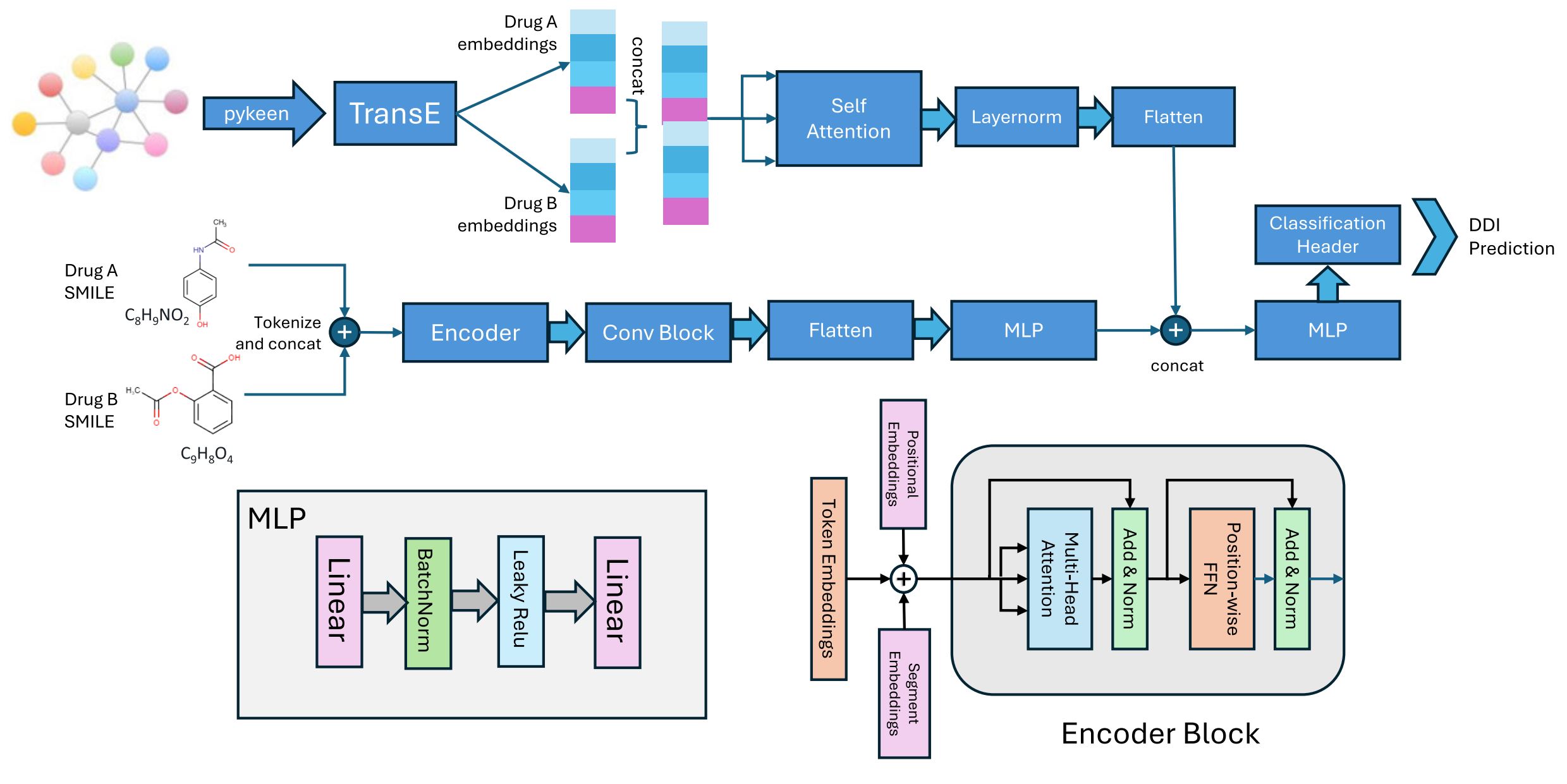
It is a common practice in modern medicine to prescribe multiple medications simultaneously to treat diseases. However, these medications could have adverse reactions between them, known as Drug- Drug Interactions (DDI), which have the potential to cause significant bodily injury and could even be fatal. Hence, it is essential to identify all the DDI events before prescribing multiple drugs to a patient. Most contemporary research for predicting DDI events relies on either information from Biomedical Knowledge graphs (KG) or drug SMILES, with very few managing to merge data from both to make predictions. While others use heuristic algorithms to extract features from SMILES and KGs, which are then fed into a Deep Learning framework to generate output. In this study, we propose a KG-integrated Transformer architecture to generate an end-to-end fully automated Machine Learning pipeline for predicting DDI events with high accuracy. The algorithm takes full-scale molecular SMILES sequences of a pair of drugs and a biomedical KG as input and predicts the interaction between the two drugs with high precision. The results show superior performance in two different benchmark datasets compared to existing state-of-the-art models especially when the test and training sets contain distinct sets of drug molecules. This demonstrates the strong generalization of the proposed model, indicating its potential for DDI event prediction for newly developed drugs. The model does not depend on heuristic models for generating embeddings and has a minimal number of hyperparameters, making it easy to use while demonstrating outstanding performance in low-data scenarios.
The key contributions and novelty of this work are outlined below:
- Superior performance and accuracy compared to other related state-of-the-art models especially on predictions in the inductive dataset split setting showing good generalization.
- It is an End-to-end machine learning model with no heuristic components that rely on domain expert knowledge.
- The proposed model is lightweight, computationally inexpensive, and easy to use as it is an end-to-end pipeline requiring very few hyperparameter optimizations.
- The proposed algorithm only requires 2 inputs (KG and SMILES) as opposed to the main benchmark model which requires five (KG, SMILES, MPNN, AFP, WEAVE). These other inputs need to be generated using separate full-scale algorithms raising the dependency of the method on other models.
- The proposed architecture shows better performance at low data settings compared to the main benchmark method.
Dataset and Model link: https://drive.google.com/file/d/1NruJncBFRWO_wgIQtyvnqT-1RDl7mz5_/view?usp=sharing
References
2025
- Drug-Discovery
 KITE-DDI: A Knowledge Graph Integrated Transformer Model for Accurately Predicting Drug-Drug Interaction Events From Drug SMILES and Biomedical Knowledge GraphIEEE Access. Publication link , 2025